



THE COMPUTE ADVANTAGE
HETEROGENEOUS HYBRID COMPUTE
Heterogeneous Hybrid Compute is how our team solves hard workloads. We break the problem into parts and route each one to the best available method and machine across quantum, quantum-inspired, HPC, and classical compute. You bring the problem and the goals. We bring the platform, the specialists, and the outcome.
THE PROBLEM
Real workloads don't have one "best" solution path.
Modern technical workloads (planning, scheduling, resource allocation, complex simulation pipelines, and ML-adjacent decisioning) rarely have a single best solver or a single best machine.
Most teams pick tools and hardware too early, then pay for it later in integration, rewriting, and revalidation when requirements change. The work that matters most (decomposition, formulation, solver selection) gets shortchanged.
Our Heterogeneous Hybrid Compute approach is built for the reality that the best answer is usually a portfolio of methods, executed across different compute targets, and orchestrated by a team that has done it before.
The best approach depends on:
- How the problem is formulated
- What approximations are acceptable
- Cost and latency requirements
- Available compute resources
- The quality of results you can verify
DEFINITION
What is Heterogeneous Hybrid Compute?
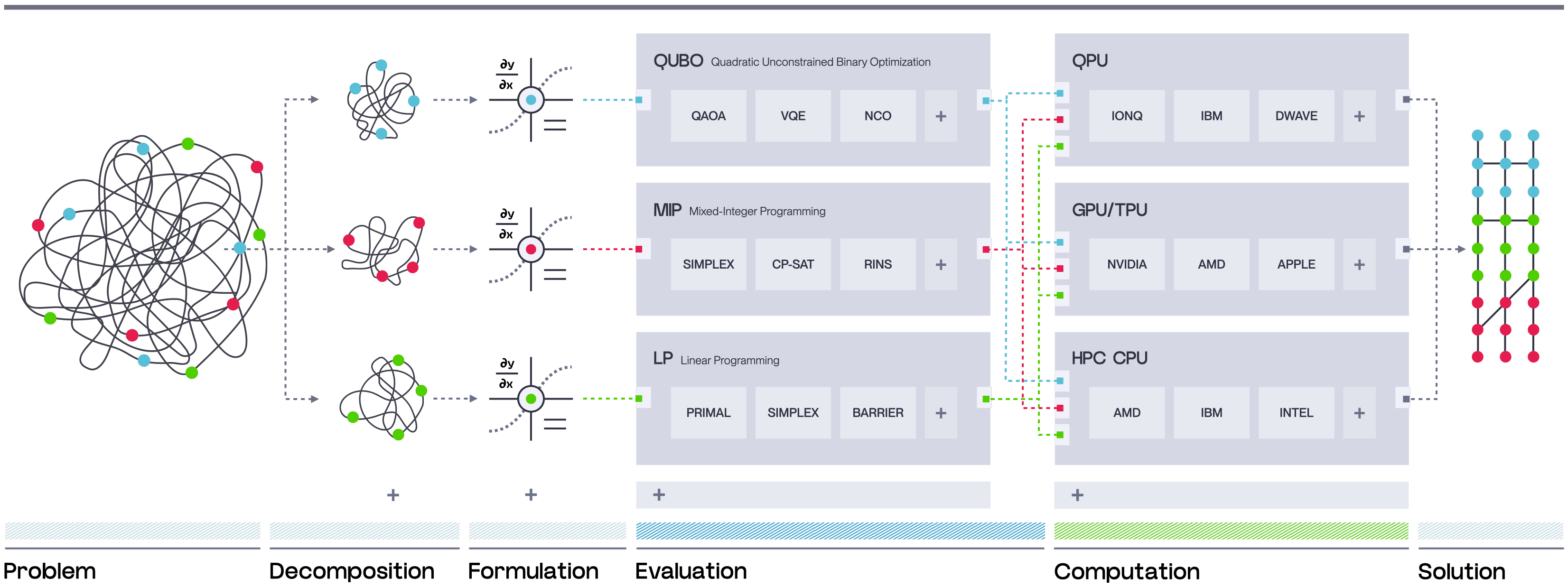
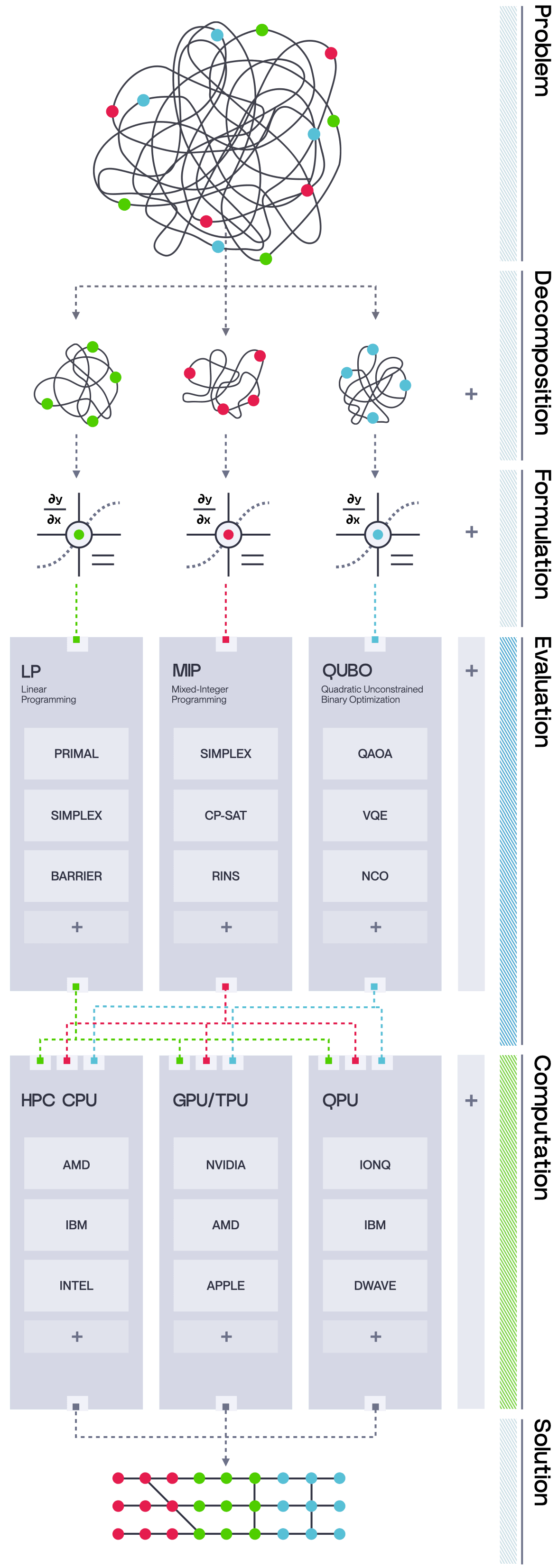
Heterogeneous Hybrid Compute is the approach our team uses to run your workload. We break the problem into executable parts and route each one to the most appropriate mix of software and compute, all coordinated through a single orchestration layer that we operate on your behalf.
What "Hybrid" Means
We produce solutions by combining multiple methods or stages, rather than betting on one solver. One method may generate candidates, another refines them, and a third validates or scores them.
What "Heterogeneous" Means
We execute methods across different backends (quantum, quantum-inspired, HPC, and classical) unified behind one platform. Heterogeneity at the workflow and execution level, not just at the chip level.
COMPUTE CATALOG
Always the best solver and machine for the job
Hybrid pipelines depend on optionality. Our catalog spans quantum, quantum-inspired, HPC, and classical providers, so we can route every step of your workload to the most appropriate compute. The broader the catalog, the better the fit for your problem, and the better the outcome we can deliver.
Optimization Solvers







Quantum Hardware







Frameworks & Cloud Platforms







Additional providers can be added by request.
END-TO-END LIFECYCLE
How we work
Every engagement runs through six stages. Our specialists work through the platform alongside your team, from the first conversation to a production result, with full visibility at every step.
Specify goals and constraints
Together with your team, we define what 'good' means: objectives and constraints, inputs and data boundaries, cost and latency targets, acceptable approximation, and governance requirements.
Decompose the problem
We break the work into parts that can be solved or evaluated independently, identifying natural boundaries and approaches we can explore in parallel.
Formulate into executable representations
We translate the problem into the forms that specific methods or solvers require. Hard problems can be represented in multiple ways, and our specialists pick the formulations that give you the best shot at a quality result.
Match each part to the best method
We evaluate state-of-the-art solving methodologies against the formulation and pick the right one for each part of the problem. No vendor agenda, just the right method.
Execute across the compute portfolio
We route the work across the catalog (quantum, quantum-inspired, HPC, and classical) using the backends that fit your cost, latency, and quality requirements.
Analyze, compare, and iterate
We review results with you using consistent metrics, surface tradeoffs clearly, and iterate. Adjust formulations, reroute execution, or re-run with different budgets until the outcome holds up.
PLATFORM
The platform we work through
HHC is not a single solver. It's a system of first-party components, algorithms, libraries, and SDKs that our specialists compose and build with on every engagement.
Workflows
We translate your intent into structured problem specifications and executable plans, with AI-assisted steps where they help us move faster.
Algorithms
First-party components we combine on demand: algorithms, transforms, evaluators, and adapters for the execution pipelines we build for your problem.
Integrations
We incorporate third-party tools your team already uses, plus bespoke applications we build when the problem demands it.
DIFFERENTIATION
Why this is different
You engage a team, not a tool. The platform stays in our hands. The outcome lands in yours.
Problem-first, not hardware-first
We start with your problem and constraints, not a fixed solver or a fixed machine. Our specialists find the viable execution paths, you set the direction.
Solver-agnostic by design
Every other vendor has a solver to sell. We pick whatever's mathematically best for each part of your problem: classical, quantum-inspired, HPC, or hybrid. No agenda, just the right answer.
Specialists plus platform
PhD-level optimization and quantum specialists working through one orchestration layer. The combination is what makes the engagement scale.
TRUST & DEFENSIBILITY
How we think about quantum
Quantum isn't the right choice for most problems today, and we'll tell you when it isn't. With HHC, we can decompose your problem and run parts against quantum and quantum-inspired backends alongside classical methods, so you find out objectively, not based on a vendor pitch.
That positions you to take advantage of quantum the moment it becomes practical for your workload, with a partner who has already done the work.
- Quantum is one execution target we evaluate, never the default choice
- We benchmark results objectively against classical baselines
- Most workloads today will get better results from quantum-inspired or classical methods, and we'll say so
- You're ready when quantum crosses the practicality threshold for your problem
FAQ
Frequently Asked Questions
Is this just heterogeneous CPU/GPU scheduling?
No. Traditional heterogeneous computing focuses on mapping low-level kernels across devices. HHC is how our team approaches the harder layers: problem decomposition, method selection, and execution across solvers, toolchains, and backends within one engagement.
Do I need in-house quantum or optimization experts?
No. That's why you engage us. Our specialists handle the parts that require deep expertise (formulation, solver matching, quantum where it fits) while your team contributes the domain knowledge and data judgment.
Does this replace my existing tools?
Usually we complement them. We integrate with what your team already uses, fold in third-party tools where they help, and only recommend a swap when there's a clear, measurable reason.
How is this different from licensing a solver?
A solver gives you one tool. HHC is an engagement: our specialists, our orchestration platform, and the full compute catalog applied to your problem. You get the outcome, not the obligation to operate the platform.
Who decides what runs where?
We make the recommendation based on feasibility, cost, latency, and quality tradeoffs. You make the final call. The platform shows the full reasoning so the choice isn't a black box.

Bring us a hard workload.
If you have a problem with real constraints (cost, latency, quality, governance), tell us about it. We'll show you what an engagement with our team and the HHC approach can do with it.